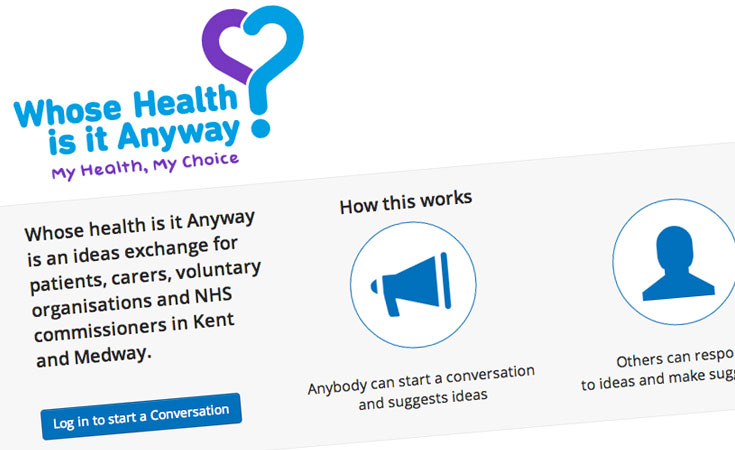
A collaborative digital platform empowering patients and NHS Commissioners across Kent and Medway.
What we did
- Custom Web Development
- ExpressionEngine CMS Implementation
- User Interface (UI) & User Experience (UX) Design
- Secure Data Reporting Portals
- Social Media API Integration
- Data Visualisation Dashboards

About the project
In the complex ecosystem of the National Health Service, the distance between service users (patients) and service planners (Clinical Commissioning Groups or CCGs) can often feel vast. In 2014, the "NHS Patients in Control" initiative sought to bridge this gap within the Kent and Medway region. The goal was to launch a digital platform titled “Whose Health Is It Anyway?” - a revolutionary ideas exchange designed to democratise healthcare planning.
The project was born from a need to move beyond static feedback forms and town hall meetings. The NHS required a dynamic, "always-on" channel where patients, carers, and voluntary organisations could engage directly with decision-makers. Tinderhouse was commissioned to architect a solution that would not only facilitate this dialogue but also transform the resulting noise into structured, actionable data for commissioners.
By creating a responsive, accessible web platform, we enabled a two-way conversation. Patients gained a voice to suggest improvements and highlight issues, while NHS Commissioners gained a powerful listening tool. The project represented a significant shift towards transparency and patient-led service design, utilising robust web technologies to handle sensitive dialogue securely and effectively.
The Challenge
The primary challenge facing the Kent and Medway NHS ecosystem was not a lack of feedback, but a lack of structure and engagement. Traditional methods of gathering patient views were slow, bureaucratic, and often resulted in low participation rates.
Specific pain points included:
Siloed Information: Valuable insights from patients were often lost in emails or paper surveys, making it impossible for CCGs to identify regional trends.
Passive Engagement: Existing channels were one-way streets. There was no mechanism for patients to discuss ideas with each other or for the community to validate suggestions.
Data Discoverability: Commissioners struggled to access findings. There was no centralised dashboard to view, filter, or analyse the qualitative data coming from the public.
Accessibility Barriers: The solution needed to be user-friendly for a diverse demographic, including the elderly and those with limited digital literacy.
Authentication Friction: Requiring complex sign-up processes often deterred users from participating in public sector consultations.
Our Solution
Tinderhouse approached this project with a focus on removing barriers to entry and gamifying the feedback loop. We understood that for the platform to be successful, it had to be as engaging as a social network and as secure as a corporate intranet.
A Validated, Phased Strategy
Given the novelty of a "social" platform for NHS feedback, we avoided a heavy-handed, monolithic launch. Instead, we adopted a minimum viable product strategy to test the core concept: the conversation portal. By focusing on the essential features of dialogue and voting first, we ensured the platform effectively met user needs before layering on complex administrative tools. This MVP approach allowed us to validate that patients were willing to engage digitally before further investment was made in the data mining tools.
The 'Whose Health Is It Anyway' Portal
We built the core user experience around a "conversational portal." Drawing inspiration from successful Q&A platforms like StackOverflow, we implemented a voting system that allowed users to promote ideas and suggestions. This was a critical feature; it meant that the most pressing issues naturally bubbled to the surface through community consensus, rather than being buried in a chronological list. To further reduce friction, we integrated OAuth login capabilities, allowing users to sign in using their existing Facebook, Twitter, or Google+ accounts.
Built on ExpressionEngine
For the technological foundation, we utilised ExpressionEngine, a robust Content Management System (CMS) known for its security and flexibility. As experienced ExpressionEngine developers, we leveraged the platform to handle the complex relationships between different user types—Patients, Carers, Voluntary Organisations, and Commissioners—without compromising on performance. The CMS allowed us to build a custom responsive framework that worked seamlessly across desktops, tablets, and mobiles.
Empowering the Community
To foster a sense of ownership, we introduced the concept of "Patient Champion" status. This feature gamified the experience, rewarding active and helpful users with increased visibility and trust levels within the system. This not only encouraged repeat engagement but also helped self-regulate the community, as senior users could help guide new participants.
Intelligent Data Mining for CCGs
While the front end was about conversation, the back end was about intelligence. We developed a secure reporting and documentation repository specifically for NHS Commissioners. This included a bespoke dashboard that translated the unstructured data from the conversation portal into visual, top-level reports. We built custom filter options that allowed data mining by demographic, topic, or sentiment, extending the reach of the data and exposing findings directly to the CCGs in a format they could use for strategic planning.
The Results
The "Whose Health Is It Anyway" platform successfully transformed how patient data was collected and utilised across Kent and Medway. By shifting from passive surveys to active community building, the NHS saw a marked improvement in the quality of feedback.
Structured Data Acquisition: The platform successfully converted unstructured public opinion into structured, analysable data, ready for inclusion in commissioning strategies.
Increased Engagement: Social login integration and the voting mechanism significantly higher participation rates compared to previous digital consultation attempts.
Scalable Architecture: The open, flexible platform proved capable of handling growing user numbers and increasing data loads without performance degradation.
Empowered Stakeholders: Voluntary organisations and Patient Champions felt genuinely heard, leading to a stronger relationship between the public and the public sector.
Actionable Insights: CCGs received a clear, filtered view of public sentiment, allowing for more responsive healthcare planning.
Technical Highlights
ExpressionEngine CMS: Chosen for its superior security architecture and content flexibility.
Social API Integration: Facebook, Twitter, and Google+ OAuth for seamless authentication.
Responsive Web Design: Ensuring full accessibility across all device types.
Custom Voting Logic: Algorithm-based ranking system for user-generated content.
Data Visualisation: Dashboard widgets for real-time reporting.
Role-Based Access Control: Strict separation between public, patient champion, and admin/CCG data views.
Ready to transform your public sector digital engagement?
Whether you need a secure data dashboard or a user-facing community platform, Tinderhouse has the expertise to build compliant, high-impact solutions for the healthcare and public sectors.