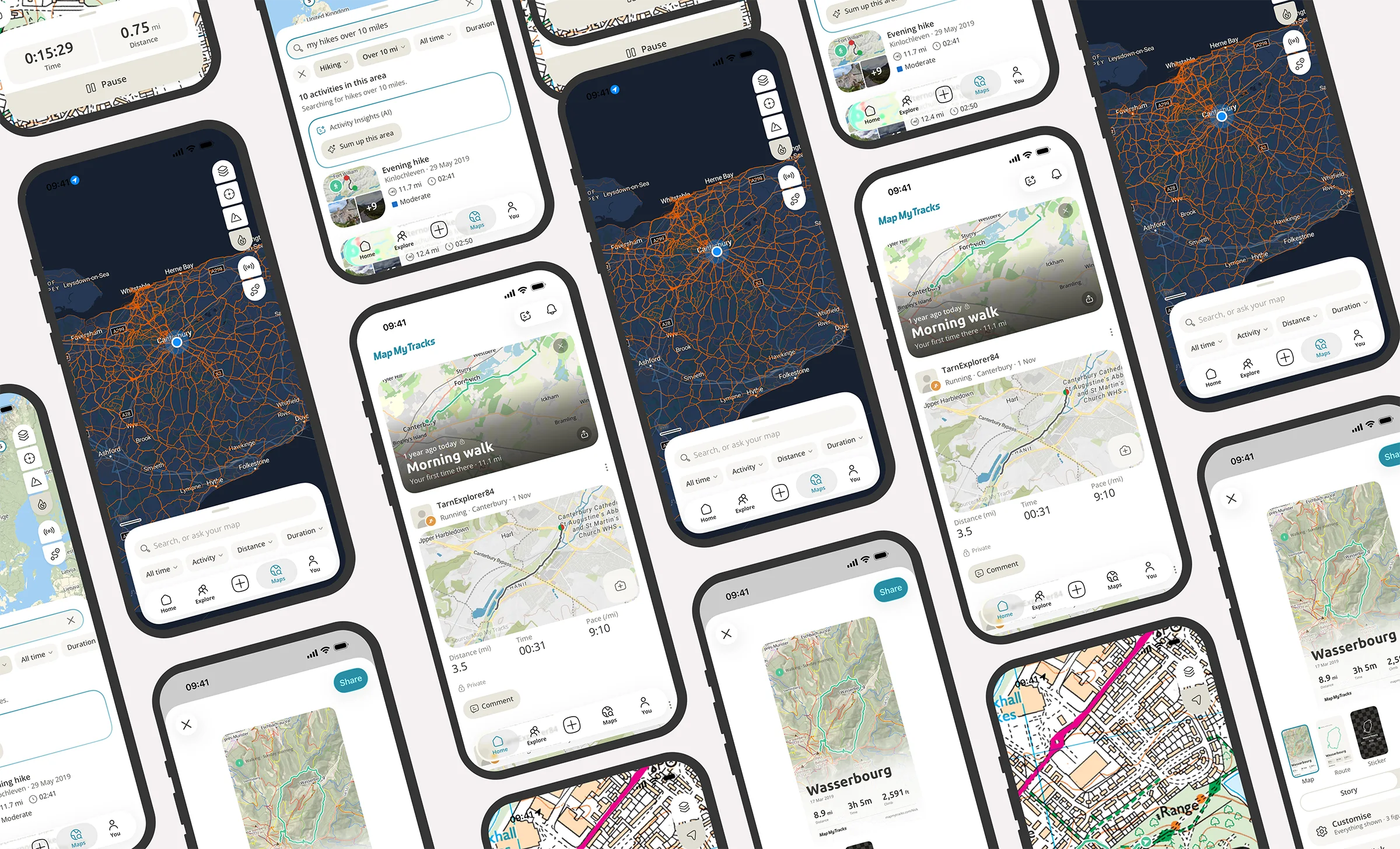
Map My Tracks puts AI to work on every walk, ride and run: insights written from each member's own history, sports science worked out by our code and every number checked, inside an all-new iPhone app.
What we did
- Built AI into Map My Tracks: an insight after every outing, a map that answers questions in your own words, and suggested notes and photo captions
- Designed the AI so our code works out the facts and the language model only puts them into words, with every number checked before a member sees it
- Turned sports science into figures that the app, the website and the AI all read the same way: aerobic decoupling, VO2max and training zones
- Built a workout planner that turns a session described in words, typed or spoken, into a structured workout in the rider's own zones
- Rebuilt the iPhone app around a new GPS recording engine, measured against a sports watch
- Put the recording on the Lock Screen, in the Dynamic Island and on Apple Watch, with Siri and Control Centre
- Designed one secure API serving the app, the website and the AI
- Shipped eight App Store apps in nine languages
About the project
Map My Tracks is Tinderhouse's own product: we built it, we own it and we run it, now in its 20th year. More than a million people have joined. In 2010 BSkyB commissioned its tracking for Team Sky's riders, and in 2012 it ran the official live tracking for the Tour of Britain.
That history gives us what most AI projects lack: two decades of real activity data, and members who tell us when the AI gets them wrong. Our first AI insights did. Handed a table of figures, the model repeated itself and slipped on numbers: one cyclist's last 18 notes all suggested longer Zone 2 rides.
Version 6 is our answer. We rebuilt how the AI reads a member's outings, and the iPhone app it lives in, so AI is part of how the whole platform explains a walk, a ride or a run. Nick, who founded Tinderhouse and leads Map My Tracks, is a qualified cycling coach, and the sports science reflects it.
The challenge
Core problems we needed to solve
- AI that's right: a language model handed raw figures repeats the same advice and gets numbers wrong, and members stop reading.
- Sports science that holds up: a figure like aerobic decoupling misleads when a ride wasn't paced evenly, and a number with a caveat is still read as the number.
- AI for walkers, not just athletes: most members walk, and most walks are ordinary. They deserve a useful note too.
- Every language: the app speaks nine languages, and the AI's checks have to hold in each.
- Cost and fairness: every AI call costs money, so use has to be fair and predictable.
- Data worth analysing: AI is only as good as the recording under it, and a phone's GPS is noisy.
- Modernising a 20-year-old platform: an ageing iPhone codebase, several older server APIs, and eight apps to ship.
Our solution
Code works out the facts; the model only writes
We split the job in two. Our code decides what is worth saying: comparisons with the member's own history, records and personal bests, routes they repeat, the rhythm of their week, the weather and the effort. It ranks those facts and rotates topics, so the same point isn't made twice in a row.
The language model is handed a short list of those facts and asked only to put them into words, in the member's language and at the detail they chose. Every number it writes is checked against the facts. If a note fails, the model gets one more try; after that the member sees the fact in plain words rather than a wrong number.
Three kinds of insight
Each note draws on three kinds of insight, mixed by the member's settings:
- The activity, acknowledged: "A typical 5 km for you, your third walk this week, on a wet morning."
- What stood out: "Your longest walk since June."
- Patterns over time: "Saturday has become your long-ride day: 7 of your 9 longest rides in the last three months."
Patterns are what a member can't see from the inside: a habit forming, a typical walk growing, being ahead of last year. We tuned them by replaying a year of three members' outings, until each heard about one new pattern a month, none false and none repeated.
Sports science first, then words
The figures the AI talks about are worked out once, on our server, by methods a coach would recognise. The app, the website and the AI then read the same figure.
Aerobic decoupling, how far heart rate drifts from output over a long ride or run, shows the approach. We tested our rule on 253 real long rides and runs before release. Where the data can't support the figure there is no figure, only the reason.
A VO2max estimate counts only when the effort behind it was truly flat out, judged by heart rate in its final minute. Charts show watts, W/kg or % of threshold, coloured by the member's own zones.
Ask your map
Members can ask their map questions in their own words: "my walks in the Lake District last year", "walks under an hour", "last winter". The language model turns the question into a search of their own activities, and the answer shows on the map and in the timeline.
Sum up this area tells the story of a member's outings in any part of the map. The app works out the facts from the activities in view, and the model writes them up.
Notes, captions and trips
After an outing, the app can suggest a note for it and a caption for each photo, written from the outing itself. Each is a suggestion to keep, change or ignore. Trips are named from the signs in members' photos.
Workouts described in words
On the website, a rider can describe a session, typed or spoken, such as "4 × 5 minutes at threshold with 3 minutes easy", and the planner builds it: the steps, a chart and time in each of the rider's own zones. Tested on the live model, a described session came back right in 17 of 18 runs. A library of 42 Map My Tracks workouts sits beside the rider's own.
A recording you can trust
AI is only as good as the data under it, so we wrote a new GPS recording engine for iPhone from scratch. It combines GPS, the barometer and the phone's motion sensors, weighs each reading by how far it can be trusted, and is tuned for each of the app's 41 sports.
We measured it on real outings. Over an 82 km ride it came within 0.1% of a Coros sports watch's distance, and its line stayed within 3.2 m of the watch's track 95% of the time. On a walk, it cut the false length that GPS zigzag adds from 15.3% to 2.8%.
A recording survives the app being closed and carries on with no signal. Live tracking catches up when signal returns.
Built for the iPhone of 2026
The recording shows on the Lock Screen, in the Dynamic Island and on Apple Watch, with Pause and Resume a tap away. Members can start an outing from Siri, Shortcuts, the Action button or a Record control in Control Centre, while the app still runs on older versions of iOS.
Around it sit national survey maps for seven countries, routes that work without signal, files opened from other apps, Bluetooth heart rate and power sensors, and Apple Health. "Remembered" brings back the places a member keeps returning to, and tells their year back each December.
One platform behind it
We designed one new API for the app, the website and the AI, in place of four older ones. Subscriptions are verified on our server, so PLUS follows the member, not the device.
One codebase ships as eight App Store apps, for walkers, runners, cyclists and everyone, in nine languages. We researched and rewrote their App Store listings for organic search in 15 languages.
Trust & privacy
AI that reads where someone goes has to earn its place. We built in:
- Only a member's own activities and photos go to the AI, never deleted ones.
- The model is handed facts our code has worked out, and every number it writes is checked.
- Notes and captions are suggestions; nothing is posted without the member.
- Members choose how much detail the AI gives and what it focuses on.
- Where the data can't support a figure, the app says why instead of guessing.
- Each AI feature has a daily allowance, so use stays fair and costs stay predictable.
- Share pictures leave out the first and last 200 m of every route, so a picture never shows where someone lives.
The results
- AI insights in three kinds, for walkers as much as racers, tuned on a year of real outings to about one new pattern a month, none false
- Every number the AI writes checked before a member sees it
- Aerobic decoupling tested on 253 real long rides and runs, and read the same way in the app, on the website and by the AI
- A workout described in words built right in 17 of 18 test runs
- GPS distance within 0.1% of a sports watch over 82 km
- Version 6.0.0 submitted to the App Store for all eight apps on 9 November 2026
- One API for the app, the website and the AI
Technical highlights
- Large language models grounded in facts our own code computes, with every number checked
- A fact layer that ranks what is notable against each member's history and rotates topics
- Sports science models: aerobic decoupling, VO2max, critical power and training zones
- Natural-language search over a member's own activities
- Typed and spoken descriptions turned into structured workouts
- An in-house GPS recording engine combining GPS, barometer and motion sensors, tuned for 41 sports
- Native iOS throughout: Live Activities, Siri and Shortcuts, widgets, Control Centre and Apple Watch
- Bluetooth sensors and Apple Health
- One versioned API for the app, the website and the AI, with sign-in tied to the device
- Every AI and engine change tested by replaying real activity histories
Planning an AI-powered sports or fitness app?
Putting a language model in front of athletes is easy. Making it right, in their language and about their own data, is the hard part, and it's what we've built at Map My Tracks.
If you're planning a sports, fitness or outdoor app with AI at its heart, talk to us about AI app development or sports app development, or get in touch to discuss your project.