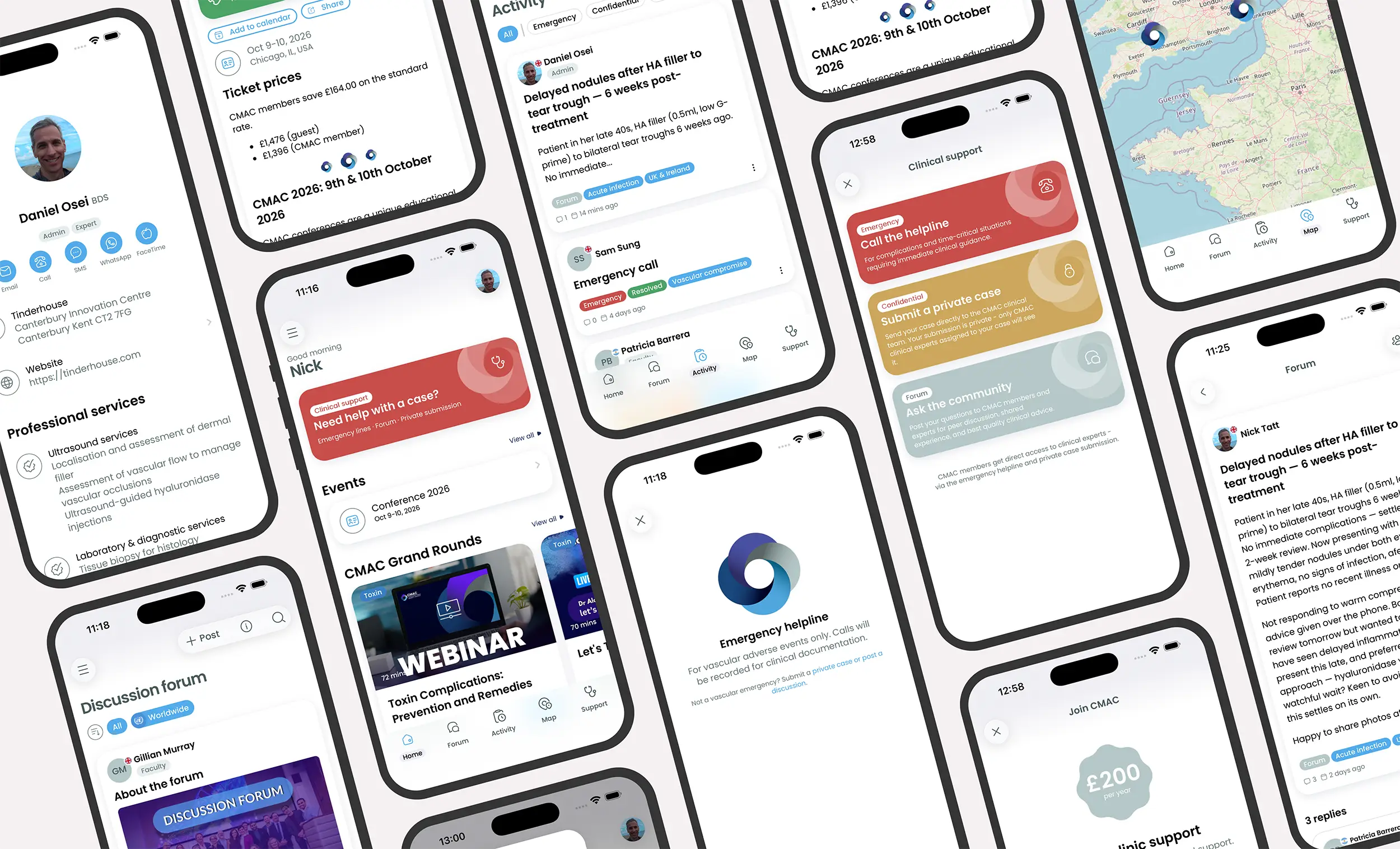
A VoIP emergency helpline, AI-assisted case triage and global membership platform for the Complications in Medical Aesthetics Collaborative - built as one modern codebase and shipped natively to iOS, Android.
What we did
- Designed and built a real-time VoIP emergency helpline connecting practitioners to on-call clinical experts, worldwide
- Built an AI-assisted call transcription and structured clinical case-capture pipeline
- Implemented an eight-tier role-based access and membership system, enforced consistently across every screen
- Built a moderated member discussion forum with @mentions and live translation across English, French and Spanish
- Delivered a CPD/CME-accredited learning library with instant, client-side certificate generation
- Built Stripe-powered conference ticketing with dynamic member pricing
- Shipped a live member map with location clustering
- Delivered iOS and Android from a single, modern JavaScript/TypeScript codebase
- Localised the app into English, Spanish and French and rolled it out to members worldwide

About the project
CMAC (the Complications in Medical Aesthetics Collaborative) is a UK-registered charity (No. 1214738) founded in 2020 to help clinicians worldwide manage risk and treat complications from cosmetic injectable and laser procedures. Its membership spans regulated healthcare professionals around the world.
Before this build, CMAC's community lived in a Facebook group, and its emergency clinical support ran on an ad-hoc phone tree: workable at a small scale, but neither auditable nor fast enough as membership grew internationally. CMAC brought Tinderhouse in to design and build a single, governed platform: one login for community, education, events and, most importantly, a clinical emergency line a practitioner could trust mid-procedure.
The result is one shared, modern JavaScript/TypeScript codebase, built on current, widely-used tooling, giving CMAC native apps for iOS and Android with real native device integrations for calling, push and location, rather than three separate codebases to maintain. It's an approach built for the long term: standard, well-documented technology that any competent engineering team could pick up and extend, not a black box tied to one vendor.
The challenge
Core problems we needed to solve
- Replace an ad-hoc phone tree with something reliable enough for a genuine clinical emergency, anywhere in the world
- Route a live call to whichever on-call expert can actually take it, instantly, without a human dispatcher in the loop
- Capture accurate clinical detail from a call without adding paperwork for the expert who just took it
- Serve a multilingual, international membership without fragmenting the community into per-region silos
- Enforce constantly shifting access rules (membership tier, application status, staff role) consistently across every single screen
- Replace an engaged Facebook group without losing what made it work
- Sell memberships, event tickets and video content without giving away margin to app store commissions
Our solution
A life-saving line, answered in seconds
At the centre of the app is a one-tap emergency call. When a member raises a vascular complication mid-procedure, the app rings every available clinical expert simultaneously over VoIP: first to accept takes the call, the rest are cancelled automatically. There's no phone number to remember and no dispatcher to get through: caller and expert both use the app, and the call arrives as a native, full-screen incoming call (via CallKit on iOS, ConnectionService on Android) even if the app is closed or the phone is locked.
Routing is filtered by both country and language, not just geography: a member calling from Latin America is connected with a Spanish-speaking expert automatically, every time, with no dispatcher deciding who's the right fit and no delay while someone works it out.
AI-assisted, clinician-verified case records
Every call is recorded with spoken, GDPR-compliant consent, then transcribed and run through an AI pipeline that drafts around thirty structured clinical fields (drug, technique, presenting symptoms, complication stage, reversal agent) directly into a case record. The clinician reviews and confirms it before anything is final: the model drafts, the expert decides. The pipeline supports English, Spanish and French from launch.
Confidential case triage
Not every complication is a phone-worthy emergency. Members can also submit a structured, condition-specific case report (for injectables, devices or toxin complications) with clinical photos attached. The first expert to respond is automatically assigned the case, so nothing is left unclaimed or duplicated, and only the submitting member and their assigned regional experts can see it.
Granular, real-time access control
CMAC's membership spans eight distinct account states (from Applicant through Member and Expert to Admin), each with different rights across roughly a dozen screens. Rather than checking a server flag, the app computes a member's live subscription status client-side from their membership data, so access decisions are always current without polling the server on every screen.
A global, multilingual member community
The forum that replaced CMAC's Facebook group supports threaded discussion, clinical photo attachment, and an @mention system built on a customised rich-text editor, solving some genuinely fiddly cross-platform keyboard behaviour along the way. Any post can be translated on demand, so an English-speaking and a French-speaking member can read, and reply to, the same thread natively.
CPD/CME learning, certified instantly
CMAC's webinar library streams from a private CDN with resume-from-position playback. As an accredited provider, CMAC can issue CPD and CME certificates directly for webinars watched and sessions attended, generated as a PDF on the member's device the moment they finish, with no admin request and no wait.
Conferences and ticketing, built for margin
CMAC's annual conference runs through the app with four-tier dynamic pricing (early-bird and standard, member and non-member) calculated automatically from each member's status. Checkout deliberately opens in the system browser rather than in-app, a decision that keeps ticket and subscription revenue clear of App Store commission.
Trust & compliance
For an app built around clinical emergencies and patient-adjacent data, trust isn't a feature, it's the foundation:
- Before any emergency call is recorded, the member hears a spoken consent notice explaining what's being captured and why: consent is asked, not assumed
- Case data (call transcripts, private case submissions, clinical photos) is visible only to the submitting member and the experts assigned to review it; no one else on the platform can see it
- Members can request permanent deletion of their data at any time
- Data is encrypted in transit and at rest throughout
- Accessibility and security were build requirements from day one: targeting WCAG 2.1 AA and the OWASP Top 10 throughout, not retrofitted after launch
CMAC itself is a UK-registered charity (No. 1214738), independently verifiable on the Charity Commission register. The app was built for an organisation with an existing regulatory footprint, not a standing start.
The results
CMAC's platform launched in 2026, consolidating what had been two disconnected systems (a Facebook group and a phone-based advice line) into one governed application:
- Live globally from launch, in three languages: English, Spanish and French
- Emergency calls are filtered and routed by country and language automatically: a member calling from Latin America reaches a Spanish-speaking expert, every time, with no dispatcher in the loop
- Community, education, events and emergency clinical support now live under a single, secure login
- An emergency response that previously depended on a phone tree now reaches every available on-call expert simultaneously, over VoIP, worldwide
- Every clinical call is now recorded (with consent), transcribed and drafted into a structured case record: nothing depends on a clinician's memory after the fact
- CPD/CME certification is immediate: no admin request, no wait
- Membership, video and ticket payments no longer pay an App Store commission
Technical highlights
- Modern JavaScript/TypeScript architecture: one shared codebase, compiled natively for iOS and Android, deployed as a full native app
- Vite-based build pipeline for fast, modern tooling and hot-reload development
- Twilio Voice SDK for VoIP calling, with PushKit/CallKit (iOS) and FCM/ConnectionService (Android) for native call screens
- AI-assisted call transcription and structured clinical data extraction
- MapLibre GL + Leaflet with marker clustering for the member map
- TinyMCE, customised for atomic @mentions across iOS and Android
- DeepL API for on-demand forum translation
- Stripe (hosted payment links) for memberships, video and event tickets
- OneSignal for push notifications, isolated from the VoIP call-push channel
- Client-side PDF certificate generation (jsPDF)
- Sentry for error tracking