Established 2003. Still delivering.

Professional Services

Bespoke enterprise tools for legal, recruitment, and consultancy firms.

Tinderhouse: Specialist Professional Services UK for startups and enterprise teams

Tinderhouse provides high-level software engineering for the professional services sector, where operational efficiency and data security are the foundations of a successful firm. We recognise that legal, recruitment, and consultancy businesses often face the challenge of managing complex workflows and sensitive client information across disparate systems. For over two decades, we have partnered with professional firms to bridge the gap between manual processes and intelligent digital automation. From secure, custom-engineered client portals to AI-driven recruitment platforms, our team delivers the technical stability and precision required to scale your operations. we focus on building resilient software that increases productivity, protects your intellectual property, and provides a seamless digital experience for your clients.

We modernise professional workflows with custom-engineered portals and AI-driven automation that increase operational efficiency and secure client data management.

Discuss your project
Our team is ready to begin new projects.

What we build for legal, recruitment, and consultancy firms

Professional services firms operate under strict confidentiality obligations and regulatory scrutiny that most software simply is not designed to accommodate. The Solicitors Regulation Authority, document retention policies, and client data governance all place hard constraints on how systems are designed, where data lives, and who can access it. Tinderhouse has delivered platforms for firms across this sector, including work with Brachers solicitors and the Business for London learning portal, where compliance and usability had to coexist from day one.

Every professional firm has internal processes that no off-the-shelf product maps to properly. Bespoke web systems built around your actual workflows replace the spreadsheets, workarounds, and manual handoffs that accumulate when generic tools do not quite fit.

Client portals and secure document exchange A white-labelled client portal gives your firm a professional digital front door. Clients log in to view case progress, upload documents, and communicate securely, all within a system that enforces role-based access controls and full audit trails. For legal firms, this means meeting Solicitors Regulation Authority expectations around client communication and document handling without relying on email attachments or third-party file sharing services that sit outside your compliance framework.

Matter and case management Custom-built matter management tools can mirror the specific stages, approval gates, and document templates your firm uses. Rather than bending your processes to fit a vendor's assumptions, the system reflects how your teams actually work. This is particularly valuable for firms managing high volumes of similar matters, where automation of document generation, deadline tracking, and status updates frees fee earners for substantive work.

Internal knowledge bases and precedent libraries Consultancy and legal firms accumulate institutional knowledge that is difficult to surface when it lives across individual drives and inboxes. A well-structured internal knowledge system makes precedent documents, template libraries, and research outputs searchable and version-controlled, reducing duplication and improving the consistency of client-facing work.

Explore more →

The volume of repetitive administrative work in professional services is significant, and much of it follows predictable patterns that are well suited to automation. AI and intelligent automation in this context is not about replacing professional judgement. It is about removing the low-value tasks that consume disproportionate amounts of time.

Automated document review and extraction Legal and consultancy firms routinely process large volumes of documents: contracts, compliance submissions, due diligence packs, regulatory filings. Natural language processing tools can extract key clauses, flag anomalies, and summarise content, reducing the hours spent on initial review. The output still requires professional oversight, but the starting point is substantially better than a blank page and a stack of PDFs.

CV screening and candidate matching for recruitment Recruitment firms processing hundreds of applications per role face a particular bottleneck at the screening stage. AI-driven screening tools can parse CVs against role specifications, rank candidates by relevance, and surface qualified applicants faster than manual review. The system learns from your consultants' decisions over time, improving match quality as it processes more data.

Intelligent workflow routing Incoming enquiries, new instructions, and internal approvals all follow patterns that can be automated. An intelligent routing system assigns work based on capacity, specialism, and urgency, reducing the administrative overhead of manual triage and ensuring nothing falls between the cracks during busy periods.

Explore more →

Several professional services firms are now commercialising their internal processes as software products, turning operational expertise into recurring revenue. SaaS development for this sector requires a particular understanding of multi-tenancy, data isolation, and the compliance expectations that professional clients bring with them.

Productising internal tools A project management methodology refined over years of consultancy work, or a compliance checklist system built for internal use, can become a subscription product serving firms with similar needs. Tinderhouse's work on Athena Project Management followed exactly this path: taking domain expertise and engineering it into a scalable platform with proper subscription billing, user management, and tenant isolation.

Client-facing reporting platforms Professional firms that deliver ongoing advisory or managed services often need to provide clients with dashboards and reporting. A SaaS-style reporting layer gives each client a secure login, real-time visibility into deliverables, and exportable data, all without your team manually assembling status updates.

Subscription and billing architecture Professional services SaaS products often have complex pricing: per-seat, per-matter, tiered by firm size, or usage-based. The billing architecture needs to handle these models cleanly from launch, not as a retrofit when commercial traction arrives.

Explore more →

Larger professional firms with multiple offices, practice areas, or operating companies need internal tools that work at scale. Enterprise app development in this sector means building systems that integrate with existing infrastructure, respect complex permission hierarchies, and remain maintainable as the organisation evolves.

CRM and practice management integration Most established firms already use a CRM, accounting package, or practice management system. New tools need to integrate with these rather than replace them. Secure API connections create a single source of truth across systems, so that client records, financial data, and matter status stay synchronised without manual re-entry.

Role-based access and data governance Professional firms handle information with varying levels of sensitivity, and not every team member should see every client's data. Granular role-based access controls, combined with audit logging, ensure that data access aligns with professional obligations and internal policies. For legal firms working under SRA requirements, this is not optional.

Multi-office and cross-jurisdictional tools Firms operating across offices or jurisdictions need systems that account for different regulatory requirements, time zones, and team structures. An enterprise platform designed for this reality handles regional variation without forcing every office into a single rigid workflow.

Explore more →

For professional services firms, the website is the first point of credibility assessment. A prospective client, referrer, or candidate will form an opinion of your firm within seconds. Website development for this sector is not primarily about visual flair. It is about communicating competence, building trust, and converting the right enquiries.

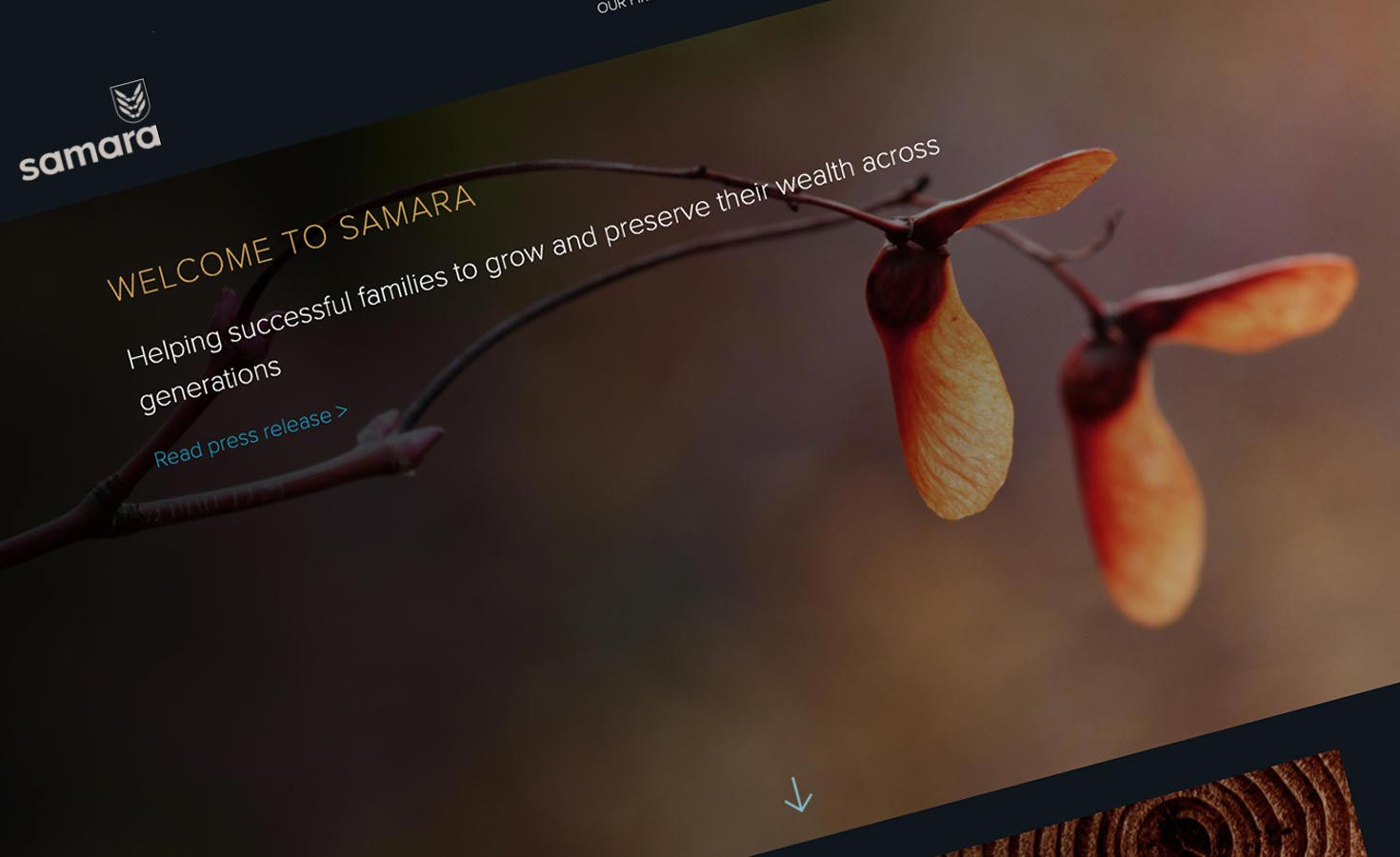
Positioning and credibility Tinderhouse's work with Samara, a multi-family wealth management office, demonstrates what a well-crafted digital presence looks like for firms where prestige and heritage matter. The platform was designed to reflect the firm's standing without resorting to stock imagery or generic corporate templates. Every design decision served a positioning purpose.

Content-led lead generation Consultancy and recruitment firms that publish thought leadership, sector reports, or market commentary need a content management system that makes publishing straightforward and keeps the site technically sound. Structured content, proper internal linking, and fast page performance all contribute to organic visibility and the kind of enquiries that convert.

Accessibility and compliance UK professional services firms are increasingly expected to meet WCAG accessibility standards, particularly those serving public sector clients or operating under regulatory scrutiny. Accessibility is not a feature to add later. It needs to be designed in from the start, covering everything from colour contrast and form labelling to screen reader compatibility.

Explore more →

Not every professional services tool needs a native app. Progressive web apps offer a practical middle ground for firms that need mobile-accessible tools without the overhead of App Store distribution and device management.

Mobile-accessible client portals A PWA-based client portal works across devices without requiring clients to install anything. They open a link, access their documents and case updates, and the experience feels like a native app. For legal and consultancy firms, this removes a friction point in client adoption whilst keeping the technology under your control.

Offline-capable field tools for recruitment consultants Recruitment consultants working from client sites, job fairs, or on the move need tools that function without guaranteed connectivity. A progressive web app can cache essential data locally and sync when a connection becomes available, ensuring that candidate notes, interview schedules, and client briefs are accessible wherever the work happens.

Cost-effective internal tools For internal tools that do not justify the cost of native development, a PWA provides a responsive, installable experience at a fraction of the budget. Training platforms, internal directories, and resource booking systems all work well in this format.

Explore more →

Many professional services firms reach a point where they need ongoing technical capability but cannot justify a full in-house development team. A fractional product team from Tinderhouse provides senior engineering, product management, and design capacity on a retained basis, scaled to your actual needs.

Ongoing platform development Firms that have launched a client portal, internal tool, or SaaS product need continued development: new features, integrations, performance improvements, and security updates. A fractional team delivers this without the recruitment, management, and retention challenges of building an internal team from scratch.

Strategic technical guidance Beyond writing code, a fractional team provides the strategic thinking that professional firms often lack internally. Which technology decisions will serve you in three years, not just three months? Where are the compliance risks in your current architecture? What should the roadmap look like? These are the questions that a retained technical partner is positioned to answer, drawing on experience across similar firms. The Business for London learning portal is one example of a long-term engagement where ongoing technical direction was as valuable as the development work itself.

Scaling up and down with demand Professional services work is often cyclical. A fractional model lets you increase development capacity during periods of investment or regulatory change, and scale back during quieter periods, without the fixed cost of permanent hires.

Explore more →

Frequently asked questions

Everything you need to know about working with Tinderhouse, from costs and timelines to our process and expertise.

Bespoke software is designed to map exactly to your unique business logic, eliminating the "workarounds" required by off-the-shelf products. We focus on automating repetitive manual tasks, such as data entry and document generation, and integrating your existing tools into a single, unified workflow. This reduces human error, frees up your team for higher-value work, and provides real-time visibility into your firm's performance.

Security is the primary consideration in all our professional services projects. We build systems using a "Privacy-by-Design" framework, ensuring full compliance with UK GDPR. Our engineering include end-to-end encryption, multi-factor authentication, and granular role-based access controls. We host our solutions on secure UK-based cloud infrastructure to ensure your sensitive data is protected against unauthorised access.

Yes. We specialise in creating secure, white-labelled portals that serve as a professional digital front door for your clients. These portals can be engineered to sync seamlessly with your existing CRM, document management systems, or accounting software via secure APIs. This provides your clients with a transparent, self-service experience while maintaining a "single source of truth" for your internal data.

We have extensive experience implementing AI to solve complex data challenges for professional firms. This includes engineering intelligent tools for automated CV screening in recruitment, natural language processing for legal document review, and predictive analytics for consultancy firms. Our goal is to use AI to augment your team's expertise, allowing for faster and more accurate decision-making.

We're proud to have worked with...

Team Sky: Elite Sports Technology Partner Willis re Sky Kent County Council Medway Council London School of Economics: Public Sector Research Systems NHS: Healthcare Digital Transformation Partner Cisco Systems: Enterprise Infrastructure Software Partner The Telegraph: National Election Platform Partner

Tinderhouse is ranked as one of the UK's top 50 mobile app development companies.

TEAM SKY
Tech partner
2010-2015
MAP MY TRACKS
#1 App
App Store (Fitness)
MAP MY TRACKS
Featured
App Store
BABY LED WEANING COOKBOOK
#1 App
App Store (Lifestyle)