High-performance web applications designed to deliver native experiences across every modern device
Progressive web app development allows businesses to combine the reach of the web with the functionality of a mobile app. At Tinderhouse, we use our 20 years of experience to build fast, reliable, and engaging PWAs that work on any platform. By prioritising performance and offline capability, we help you reach users without the friction of app store downloads or the high cost of maintaining separate codebases.
The most successful PWAs do not just mimic mobile apps. They use the unique reach of the web to solve specific user problems where friction is the enemy of conversion
Our app and website design and development areas of expertise
AI integration specialists
Web service connections
Back-end database integration
Innovative UX/UI design
Our app and website solutions are helping businesses grow, be more efficient and sell more. Let's talk about your project. Call us on +44 (0)1227 811771 or send us an email.
Why Progressive Web App Development Matters
In our two decades of building digital products, we have seen the web evolve from simple pages to complex application platforms. Progressive web app development (PWA) represents the current peak of this evolution. It allows for a single codebase to serve users on desktops, tablets, and smartphones while maintaining high performance. As of 2026, browser support for advanced web APIs has made PWAs a primary choice for enterprise and consumer tools alike.
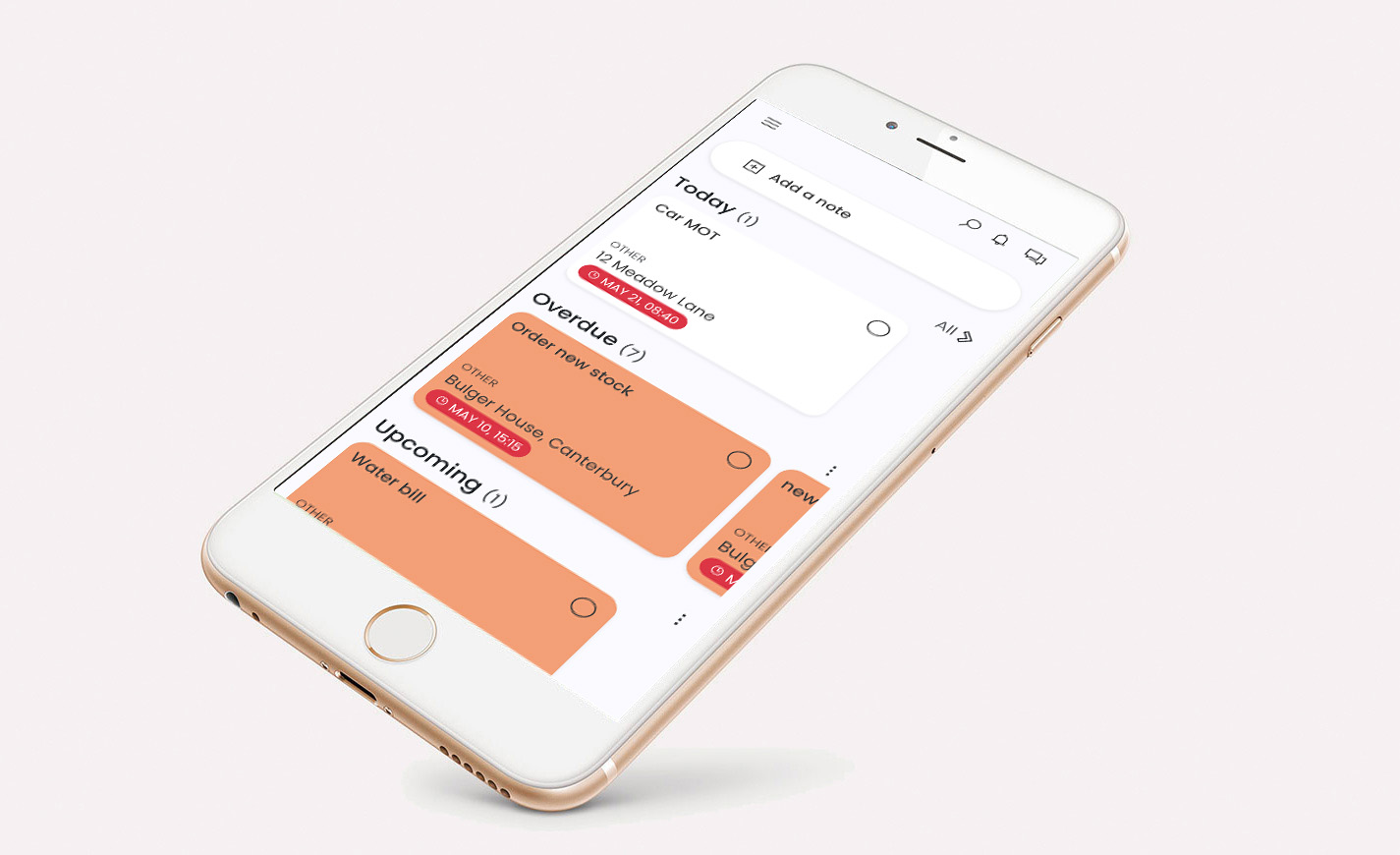
The business value of a PWA lies in its accessibility. Because these apps are accessed via a URL, they bypass the hurdles of the Apple App Store or Google Play Store. This reduces user acquisition costs and simplifies the update process, as you only need to manage one deployment. We have applied this logic to various projects, including a PWA for a property company used for staff task management, where ease of access was more critical than a store presence.
What is Progressive Web App Development?
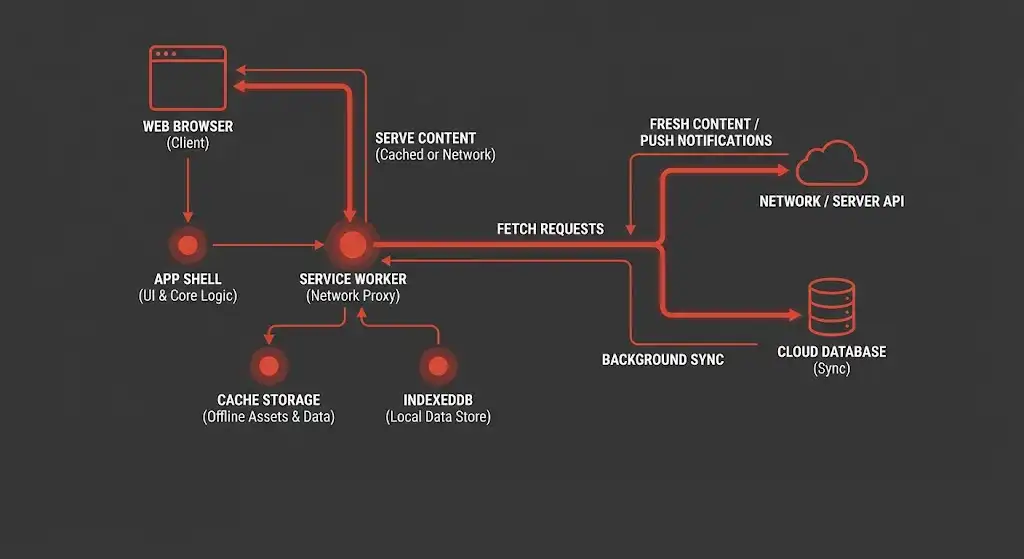
Performance-First Engineering: Our PWA architecture leverages Service Workers and local IndexedDB storage to provide native-level speed and 100% offline functionality, bypassing the friction of traditional app stores.
Progressive web app development is the practice of building web applications that use modern browser features to provide a mobile-like experience. Unlike traditional websites, a PWA is designed to be "progressive," meaning it works for every user, regardless of browser choice, because it is built with progressive enhancement as a core principle.
A common comparison our clients ask for is PWA vs Native apps. Native apps are built for specific operating systems (like iOS or Android) and must be downloaded. In contrast, a PWA is a website that can be "installed" on a home screen without a store. It relies on a web app manifest (a JSON file that tells the browser how your app should look and behave when installed). This includes defining the home screen icon and the theme colour of the browser UI.
Why Businesses Choose Progressive Web App Development
Many organisations choose PWA development because it significantly reduces the total cost of ownership. Instead of hiring separate teams for iOS, Android, and Web, you invest in a single, high-quality hybrid app development project that serves all users. This approach also shortens the time-to-market, as seen in our work on an MVP financial education app that launched within just 8 weeks.
PWAs also improve user retention through features like push notifications and offline access. For a commercial music producer, we developed a web portal for artist booking that utilised PWA principles to ensure planners could view schedules even with spotty connectivity. The ability to work offline, powered by service workers, ensures that your business logic remains available to users at all times.
The Progressive Web App Development Process
Our process focuses on creating a resilient architecture that scales. We break development into distinct stages to ensure technical debt remains low. Our approach to every project is built on a proven mvp app development framework, where we use a rigorous technical discovery phase to turn complex ideas into high performance, market ready applications.
Discovery and Architecture
We begin by defining the app shell model. This is the minimal HTML, CSS, and JavaScript required to power the user interface. By separating the UI shell from the dynamic content, we ensure the application feels instantaneous when a user opens it. This stage often involves our SaaS development expertise to plan how data will flow between the server and the client.
Offline-First Development
We implement an offline-first architecture. This means we design the application to function without an internet connection by default. We use service workers (scripts that run in the background, separate from the web page) to intercept network requests. These scripts cache essential assets and data, allowing the app to load from the local device rather than waiting for a slow network.
Testing and Deployment
Testing a PWA involves more than just checking browser compatibility. We test "lie-fi" scenarios where a connection is present but unusable. Our team uses CI/CD pipelines (automated testing and deployment systems) to catch bugs early. This was crucial for the My Lost Account banking portal, which is used daily by every major bank in the UK and requires absolute reliability.
Common Mistakes to Avoid
In our experience, many PWA projects fail because they treat the web app like a standard website. One major pitfall is ignoring technical debt. This is the long-term cost of taking shortcuts during development. If service worker logic is not properly documented, it can lead to "ghost" versions of the app being stuck in a user's browser.
Another mistake is failing to handle data synchronisation. When a user makes changes offline, the app must resolve conflicts once the connection returns. Without a robust strategy, you risk data loss. We saw the importance of this while building a field worker app for health and safety compliance, where data integrity was a legal requirement.
Cost and Timeline for PWA Projects
The cost of progressive web app development is influenced by the complexity of the offline logic and the number of third-party integrations required. A simple PWA might take 10 to 12 weeks, while a complex enterprise tool can take several months. For example, our work on the Verenigma app involved complex voice recording analysis, which naturally extended the timeline compared to a standard task management tool.
Timeline expectations are usually shorter than native development because there is no app store approval process. However, we always advise clients to factor in time for rigorous cross-browser testing. While PWAs are "progressive," ensuring a consistent experience on both the latest Chrome and older versions of Safari requires a disciplined approach.
Is This Right For You?
Progressive web app development works well if you:
Need to reach a broad audience across different devices with a single budget.
Require your application to function in areas with poor or no internet connectivity.
Want to update your application frequently without waiting for app store reviews.
This may not be right if:
Your app requires deep integration with specific hardware sensors that are only available to native app development.
Your business model relies heavily on the visibility and "prestige" of the Apple App Store.
How Tinderhouse Works
We are mobile app development London specialists who have been working with web technologies since the early days of the internet. We use API-first architecture (designing the data layer before the interface). This ensures that the backend of your PWA is ready for any future integrations, whether that's a wearable app or an AI-driven dashboard.
Our team with a deep technical background allows us to build highly customised CMS-driven PWAs that are easy for your internal teams to manage. We provide ongoing support across all projects, ensuring that as browser standards change, your PWA remains functional and secure.
Ready to Discuss Your Project?
We've helped businesses across the UK turn technical challenges into working solutions. Whether you're at the planning stage or ready to start development, we're here to provide honest advice and clear guidance.
Call us on +44 (0)1227 811771 to discuss your project, or send us an email using our contact form.
Build, test, and validate your product idea in weeks, not months
Explore more →
Frequently asked questions
Everything you need to know about working with Tinderhouse, from costs and timelines to our process and expertise.
Yes, PWAs are inherently cross-platform. They run in the browser, meaning they work on any device with a modern web engine. While iOS has historically been slower to adopt certain features, it supports the essential PWA requirements, including service workers and the web app manifest.
Usually, no. A well-built PWA can replace the need for separate iOS app development and Android app development. This is one of the primary progressive web app benefits, as it consolidates your development efforts into one codebase.
Push notifications use the Push API and the Notifications API. This allows the server to send messages to the service worker, even when the browser is closed. The service worker then displays the notification to the user. This is a powerful tool for fitness and wellness apps to keep users engaged.
PWAs must be served over HTTPS, which provides a baseline of security. For more sensitive applications, such as healthcare app development, we implement additional layers like role-based access control and data encryption to ensure compliance with industry standards.
PWAs use IndexedDB, a large-scale NoSQL storage system in the browser. This allows the app to store significant amounts of data locally. When the user reconnects, the service worker synchronises these local changes with your central database, a process we have refined over many enterprise app development projects.
We always recommend beginning with a technical discovery phase. By focusing on mvp app development as the first milestone, we can validate your core features and architecture before committing to a full scale rollout. This lean methodology reduces risk and ensures your product is engineered to scale from day one.
Every project we launch comes with a 90-day post-launch warranty. At Tinderhouse, we believe execution doesn't end at 'Go-Live.' For the first three months after launch, our UK-based team handles any technical issues, bug fixes, or performance refinements within the original project budget. This ensures your software or AI system is fully stable in a real-world environment before transitioning to long-term support, protecting your investment and ensuring a seamless experience for your users.