High-performance applications designed for the unique constraints of wearable technology
Tinderhouse provides expert wearable app development, creating lightweight, purposeful software for Apple Watch, Wear OS, and bespoke hardware. With over 20 years of experience in mobile and web development, we help founders and product leads translate complex functionality into glanceable, battery-efficient wearable experiences. Whether you require a standalone fitness tracker or an enterprise health and safety tool, our team delivers technical excellence from our Kent and London offices.
The most successful wearable apps do one thing exceptionally well in under five seconds. If a user has to stay on their wrist for longer, you have probably built the wrong feature.
Our app and website design and development areas of expertise
AI integration specialists
Web service connections
Back-end database integration
Innovative UX/UI design
Our app and website solutions are helping businesses grow, be more efficient and sell more. Let's talk about your project. Call us on +44 (0)1227 811771 or send us an email.
Why Apple Watch & Wear OS App Development Matters in 2026
As of 2026, wearable technology has moved beyond simple notifications to become a primary interface for health, fitness, and industrial compliance. Wearable app development requires a fundamentally different mindset compared to standard mobile apps because the hardware constraints are significantly tighter.
We focus on creating software that complements a user's lifestyle or workflow without being intrusive. Our work on Map My Tracks, which reached the #1 spot in the App Store Fitness category, taught us that reliability in the field is the most important metric. When a user is in the middle of a workout or a high-pressure work environment, the app must work instantly, even with intermittent connectivity.
Modern wearable development now allows for more "standalone" functionality. This means the watch app can operate independently of a smartphone, using its own Wi-Fi or cellular connection to sync data. We help technical leads decide when to use this approach to improve user freedom and when to stick to a tethered model to preserve battery life.
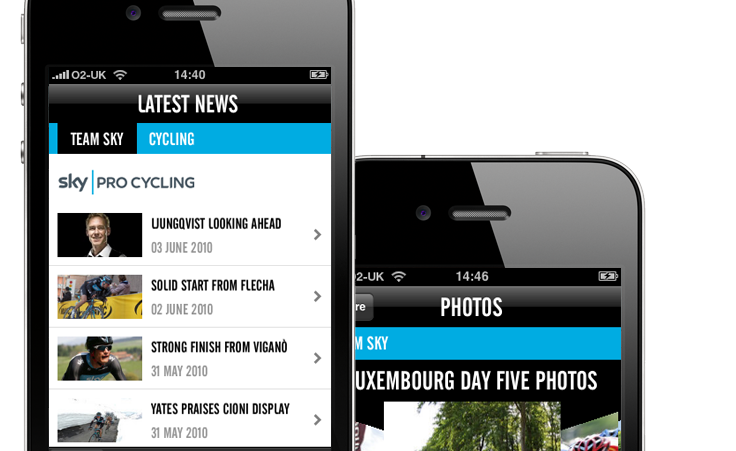
Our experience delivering real-time biometric tracking for Team Sky professional riders, heart rate, power output, cadence, and GPS data, informs our approach to wearable app development at every level.
What is Wearable App Development?
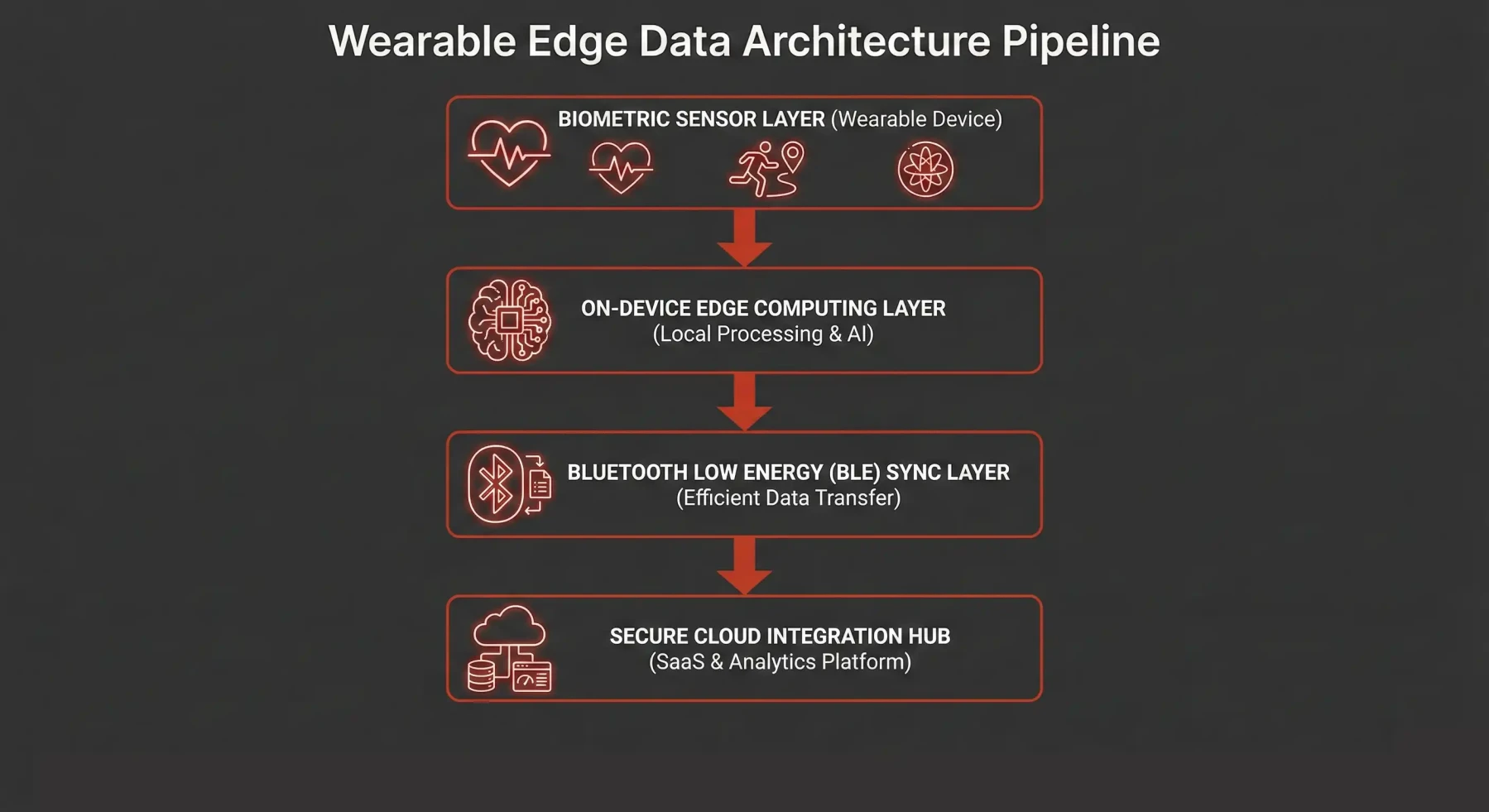
Engineering for the Edge: Our wearable architecture prioritises on-device processing and efficient BLE protocols to ensure high-performance data tracking without compromising battery longevity.
Wearable app development is the process of building software specifically for devices worn on the body. Unlike smartphones, these devices have limited screen real estate, smaller batteries, and specialized sensors like heart rate monitors and accelerometers.
To build effectively, we focus on three primary entities:
Glanceable Interface: This is a UI design philosophy where information is consumed in seconds. We prioritise high-contrast visuals and essential data points to ensure the user isn't frustrated by complex navigation.
Bluetooth Low Energy (BLE): This is a wireless communication protocol designed to provide significantly reduced power consumption. We use BLE to ensure your wearable can talk to other devices or sensors without draining the battery in an hour.
Background Fetching: This is a technical process where the app updates its data in the background even when not actively in use. This ensures that when the user raises their wrist, the information is already current.
A common misconception is that a wearable app should be a "mini" version of a mobile app. In reality, it should be a specialized tool. While a mobile app development project might focus on feature richness, a wearable project focuses on immediate utility and sensor accuracy.
The AI Shift: Agentic AI on the Wrist
"Wearable technology is no longer just about data collection; it is about autonomous intervention. We specialise in building wearable apps that leverage Agentic AI to process biometric data at the Edge. By moving reasoning tasks from the server directly to the device, we enable real-time health alerts and industrial safety triggers that function with zero latency and total data sovereignty."
Why Businesses Choose Wearables for Growth
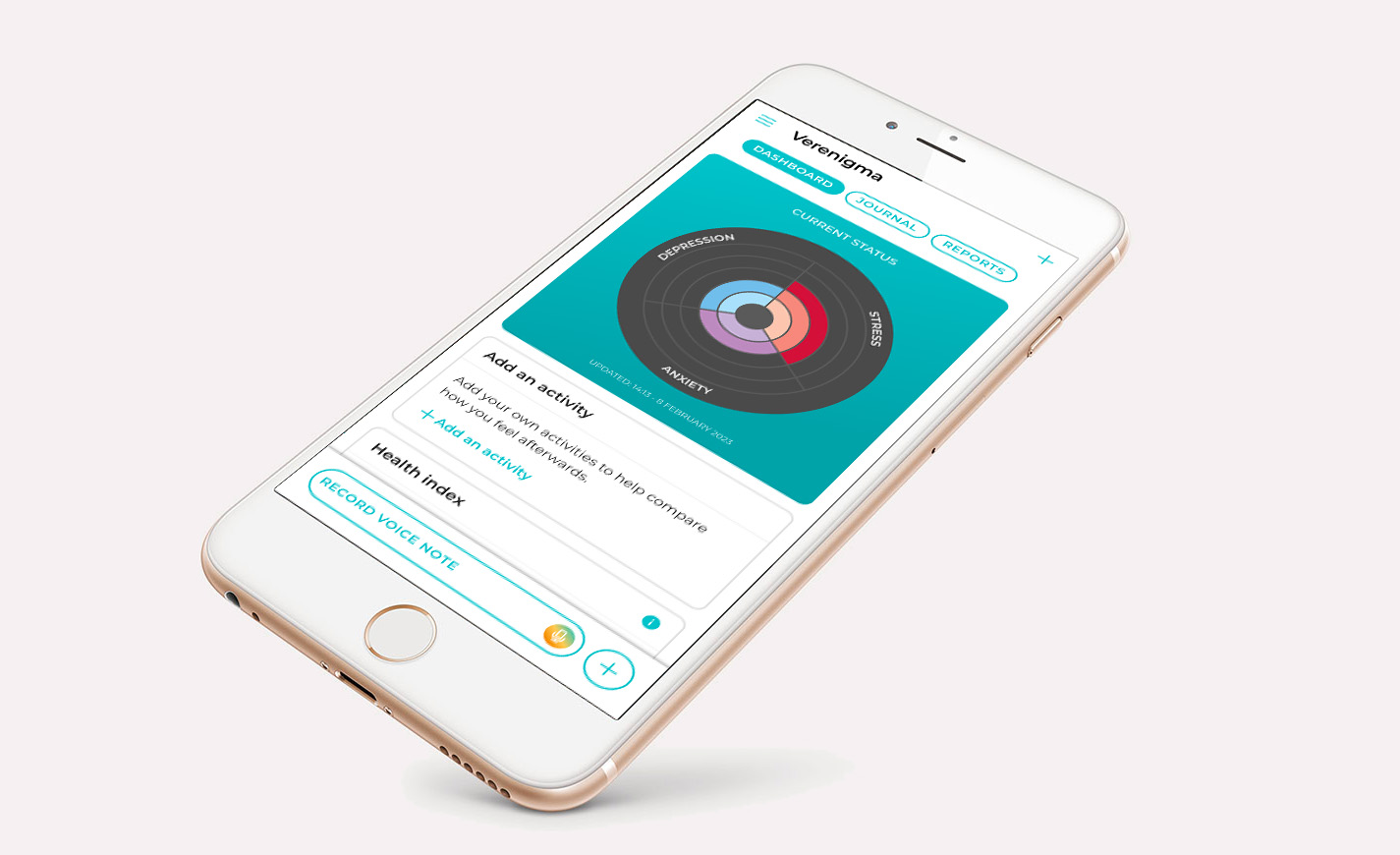
Investing in wearable technology allows businesses to capture data that is otherwise inaccessible. For example, our work on the Verenigma app involved voice recording analysis to monitor stress and anxiety. This level of biometric engagement is only possible through devices that are consistently near the user.
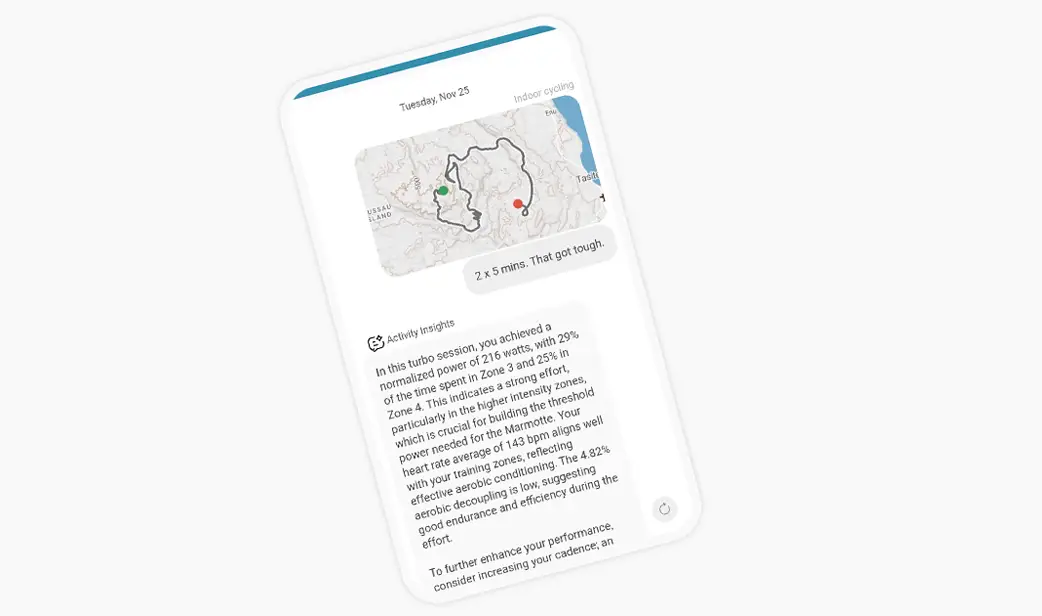
Proven at Scale with Activity Insights (2026): Our Map My Tracks Activity Insights feature, launched in 2026, demonstrates our capability to deliver AI-powered wearable experiences at scale. The system provides real-time coaching feedback directly to Apple Watch, analysing GPS, heart rate, and power data to generate personalised training recommendations. This positions us at the forefront of wearable AI integration, moving beyond passive tracking into intelligent, adaptive coaching systems that function entirely on-device.
Businesses typically choose wearable solutions to achieve four outcomes:
Real-time Compliance: For our field worker app project, we used wearable technology to streamline health and safety compliance.
User Retention: Fitness and health apps see higher engagement when users can track progress without reaching for a phone.
Operational Efficiency: In enterprise settings, wearables allow for hands-free task management, such as the PWA for a property company we developed for staff task tracking.
Faster Data Cycles: Biometric and location data can be pushed to a central SaaS development platform for immediate analysis.
The Wearable Development Process
Our process is built on Agile methodology. These are short development cycles that let us adapt as we learn about user behaviour through real-world testing. Our approach to every project is built on a proven mvp app development framework, where we use a rigorous technical discovery phase to turn complex ideas into high performance, market ready applications.
1. Technical Discovery and Scoping
We begin by identifying the "critical path" of the application. We define which sensors are required and whether the app will be standalone or tethered. This stage is vital for avoiding technical debt, which is the long-term cost of taking shortcuts in the initial architecture.
2. Prototyping for the Wrist
We create low-fidelity prototypes to test navigation on actual hardware. This helps us realise if a button is too small or if the information density is too high before a single line of production code is written.
3. Engineering and Sensor Integration
During this phase, we implement the core logic. For projects like Map My Tracks, this involved heavy optimisation of GPS and biometric data processing to ensure accuracy without killing the device battery. We use CI/CD pipelines (automated testing and deployment systems) to catch bugs early and release updates safely.
4. Testing in the Wild
Wearables cannot be tested only in a lab. We test for connectivity drops, "wrist-down" behaviour, and physical movement impacts. This ensures the app remains stable during the activities it was designed for.
Common Mistakes to Avoid
In our 20 years of development experience, we have seen several recurring pitfalls that can derail a wearable project.
Feature Overload: Trying to replicate every mobile feature on a watch. This leads to a confusing user experience and poor performance.
Ignoring Battery Impact: Using frequent GPS pings or high-brightness displays without optimisation. We solve this by implementing efficient background fetching schedules.
Neglecting Offline States: Wearables often lose connection. If the app breaks when Wi-Fi drops, it is useless. We design for "offline-first" architecture where data is cached locally and synced later.
Poor Notification Management: Overloading the user with "haptic" feedback (vibrations) leads to them disabling the app. Notifications must be meaningful and infrequent.
Cost and Timeline Expectations
The cost of wearable app development is driven by three main variables: the complexity of sensor integration, the number of platforms (watchOS and Wear OS), and the data synchronisation requirements.
A focused MVP for a wearable app, such as our financial education app which launched in 8 weeks, can be delivered relatively quickly. However, a complex biometric app like the Verenigma project requires more extensive testing and data validation cycles.
Generally, a production-ready wearable app takes between 3 to 6 months to develop. We provide ongoing support across all projects to ensure the software remains compatible with new hardware releases.
Is Wearable Development Right For You?
This works well if you:
Have a fitness or health product that requires biometric data.
Need a hands-free solution for field workers or industrial staff.
The primary value of your product relies on high-resolution video or complex imagery.
You are looking for a cheap, "wrapper" version of your website.
How Tinderhouse Works
We are experienced system architects who prioritise stability. Our approach to wearables is grounded in technical pragmatism.
We use API-first architecture (designing the data layer before the interface) to ensure your wearable app, mobile app, and web portal all speak the same language. This was essential for the Hansard Society web portal, where monitoring complex activity required a robust data backbone.
Our team is ranked in the top 50 UK app developers by Clutch. We don't just build apps; we manage the entire lifecycle, including TestFlight and Google Play beta testing (platform-specific tools for testing apps with real users before launch). This ensures that when your app hits the store, it has already been proven in the field.
Ready to Discuss Your Project?
We've helped businesses across the UK turn technical challenges into working solutions. Whether you're at the planning stage or ready to start development, we're here to provide honest advice and clear guidance.
Call us on +44 (0)1227 811771 to discuss your project, or send us an email using our contact form.
Build autonomous AI agents that handle specific business tasks and integrate seamlessly with your systems
Explore more →
Frequently asked questions
Everything you need to know about working with Tinderhouse, from costs and timelines to our process and expertise.
Yes, if built as a standalone app. We use Wi-Fi or cellular-enabled hardware configurations to ensure the app functions independently. This is a common requirement in healthcare app development where patients may not always have a phone on them.
We implement role-based access control and encrypted data transmission. This ensures that sensitive information, such as the banking data handled by our My Lost Account portal, remains secure even on a small device.
We can develop for both watchOS and Wear OS. While they use different languages, we often share the underlying business logic or use hybrid app development techniques where appropriate to reduce costs.
We optimise the code to reduce CPU wake-ups and use efficient data transfer protocols. We also limit the frequency of sensor polling, ensuring the device lasts a full day under normal usage.
Yes. We handle the entire submission process, including meeting specific Apple and Google guidelines for wearable UI. Our experience with Map My Tracks ensures we know exactly what reviewers look for in high-performance apps.
Absolutely. We specialise in connecting new interfaces to legacy systems. Whether it is an enterprise app development project or a bespoke web portal, we ensure the data flows correctly.
Battery optimisation for wearables requires understanding platform-specific power management. On Apple Watch, we use background app refresh intervals of 15-30 minutes rather than continuous polling, implement efficient WatchKit APIs, and leverage passive sensor data when possible. For Garmin devices with their tighter memory constraints, we optimise code to minimise CPU wake-ups.
Our Map My Tracks implementation demonstrates this at production scale: users track 6+ hour ultra-distance workouts with continuous GPS and heart rate monitoring while maintaining 40%+ battery reserves. We achieve this through adaptive GPS sampling (reducing frequency when motion is steady), batched data writes to reduce storage overhead, and efficient Bluetooth Low Energy protocols for sensor synchronization. These techniques came from supporting Team Sky riders during all-day Tour de France training sessions where battery failure wasn't an option.
Every project we launch comes with a 90-day post-launch warranty. At Tinderhouse, we believe execution doesn't end at 'Go-Live.' For the first three months after launch, our UK-based team handles any technical issues, bug fixes, or performance refinements within the original project budget. This ensures your software or AI system is fully stable in a real-world environment before transitioning to long-term support, protecting your investment and ensuring a seamless experience for your users.
We've built production applications for Apple Watch (watchOS), Wear OS, Garmin (Connect IQ), and integrated with Fitbit, Polar, Coros, Suunto, and Wahoo platforms. Our Map My Tracks fitness app demonstrates this expertise at scale, seamlessly synchronising biometric data from millions of users across multiple wearable brands.
The technical challenge varies significantly by platform. Apple Watch development requires deep understanding of HealthKit, WatchKit, and SwiftUI. Garmin's Connect IQ uses Monkey C, a proprietary language requiring specialized expertise. Wear OS demands careful battery optimization given Android's background processing model. We've solved these platform-specific challenges across hundreds of production deployments.
We build Apple Watch complications that update in real-time without draining battery, using efficient background refresh strategies and ClockKit APIs.
Our HealthKit integration expertise spans the full data ecosystem: writing workout data (heart rate, GPS, cadence, power), reading activity rings and step counts, and syncing nutrition and sleep data. We implement proper HealthKit authorisation flows, handle data conflicts between multiple sources, and ensure HIPAA-compliant data handling when required for healthcare applications. This depth came from supporting Team Sky's professional riders who needed precise power output and heart rate tracking synchronized across training platforms.