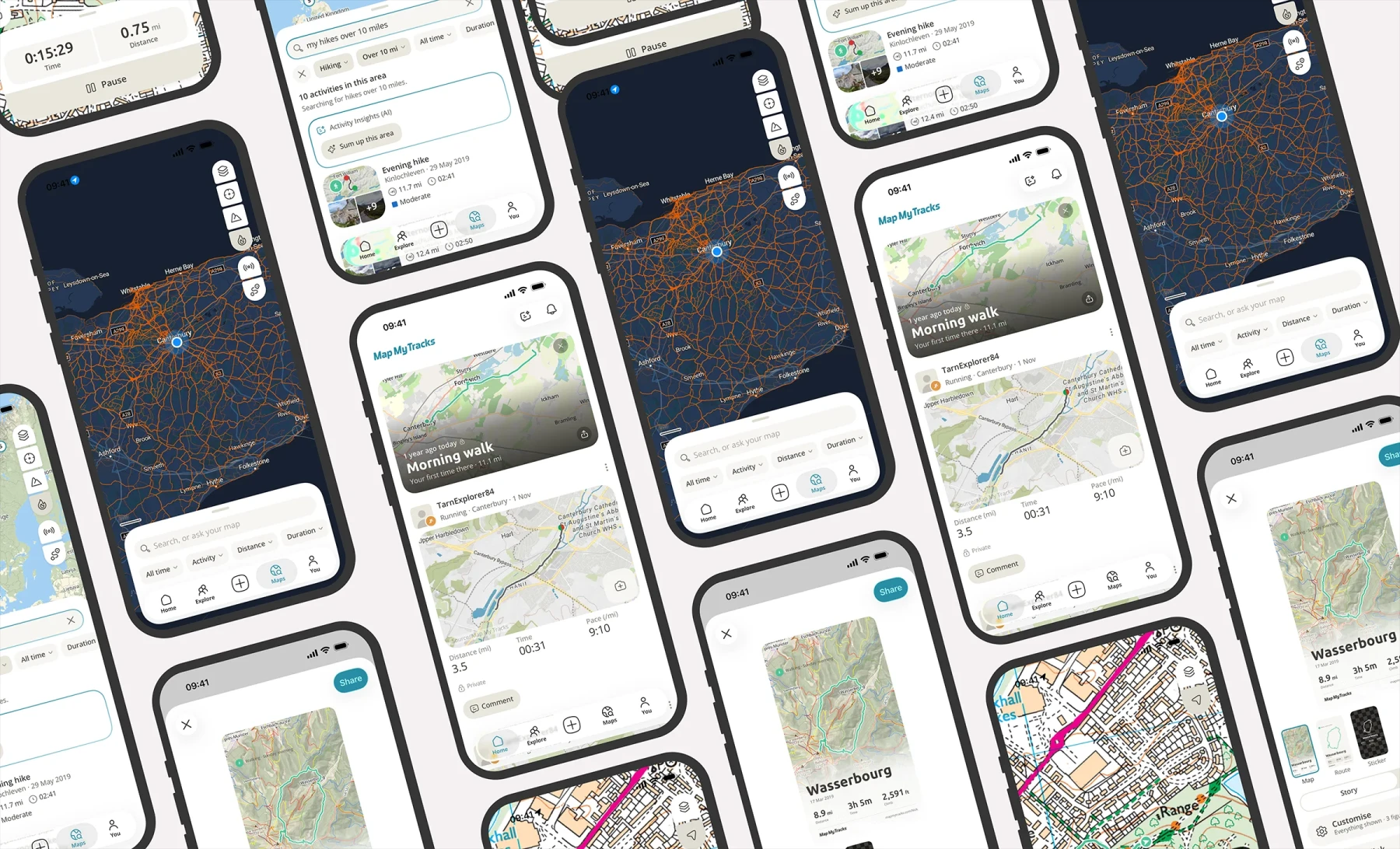
Map My Tracks has been recording walks, runs and rides since 2007. We built it and we still run it. Over the past year we've added AI to almost every corner of it: activity notes, a heatmap you can ask questions of, search that understands how people remember their days out, and a workout builder that takes a session described in plain English.
That's a very different job from building an AI product from scratch. An established platform has years of data, users who know how it behaves and an architecture that predates language models. You can't rebuild it around AI, and you shouldn't want to.
If you run a product like that and you're wondering where AI fits, here's what we learned doing it on our own.
Let the AI Handle the Words and the Code Handle the Facts
The decision that shaped everything was simple. Language models are very good with language. They're unreliable with arithmetic, and they'll state a wrong number with exactly the same confidence as a right one.
So on Map My Tracks the AI never has the final say on anything that can be calculated. Its job is to turn what a person says into structure. Ordinary code, the same code that has handled the platform's data for years, then does the counting, checks the result and decides what's shown.
That split sounds obvious written down. In practice it's the difference between a feature people trust and one they quietly stop using.
A Workout Built From a Sentence
Workouts is the clearest example. Coaches describe sessions in words: an hour of endurance with some tempo, or three by ten at threshold. Workout tools have always wanted the opposite, with every step typed into its own box and every power worked out by hand.
Now a rider types or dictates the session the way they'd say it, or pastes a plan exactly as their coach sent it. The AI's job ends once it has turned that into a list of steps.
Everything after that belongs to the planner. It reads each step itself and calculates the duration, training load and intensity from the rider's own threshold. If a line can't be read, or the session doesn't come out at the length that was asked for, the AI is sent back to look again before anything reaches the screen. The rider sees every step and can edit any of them by hand.
The AI makes the feature easy to use. The planner makes it right.
Search That Works the Way People Remember
Nobody remembers an activity by its date. They remember the walk where the cloud lifted at the top, or the ride that finished at the pub.
Search on Map My Tracks now accepts that kind of phrasing. A query like hilly walks last autumn is split into a sport, a season and a description, and each part appears as a filter the user can see and remove. Hilly is measured against that person's own history, so it means hilly for them rather than for a fell runner.
Most of this doesn't need a language model at all. Sports, dates and places are picked out by conventional parsing, and the remaining words are matched against what the user wrote at the time. The AI only steps in when the words don't fit a filter. Even then, what it produces is a set of filters rather than an answer, so the user can see exactly what it decided and change it.
Four Decisions We Made on Every Feature
The same few questions came up each time we added AI somewhere new, and we answered them the same way.
First, AI sits on top of features that already work. Search, the workout planner, the exports and the library all do their job without it. If the model is slow or unavailable, the product carries on.
Second, cost shapes the design from day one. Every AI request costs money, so allowances are built into each feature rather than bolted on later. Free accounts get enough to see the value and Plus members get more, which keeps the spend tied to the people paying for it.
Third, private stays private. Map My Tracks has always defaulted to private, and the AI features follow the same rule. A user's private activities only ever appear in that user's own results.
Finally, we show the working. Wherever the AI makes a decision, the user can see it: filters as chips, workout steps in a list, a change described in a sentence. People trust AI they can check.
What This Means for Your Product
None of this is specific to fitness. Most established products hold the same ingredients: structured data, rules the business already trusts and users who'd rather ask for things in their own words.
The questions we'd put to any AI feature are the ones we asked of our own. Which part of this is language and which part is fact? What happens when the model gets it wrong? Can the user see what it did? Does the feature still work if the AI isn't there?
Answer those well and AI makes an existing product easier to use without making it less reliable. It's how we approach our AI product engineering work, and you can see more of it in the Map My Tracks Activity Insights case study. If you're still deciding how far to go, our guide to agentic AI versus simple automation covers that choice.
Weighing up AI for a product you already run? It would be best for us to have a quick call. Book a 15 minute chat or feel free to call at any time on 01227 811771.
Need an app or website?
Get in touch to discuss how we can help create an app of your own or find out how our Fractional Product Team can support your development journey from MVP through to scale.